If you're looking for Wisconsin BadgerCare, please click here: https://www.dhs.wisconsin.gov/badgercareplus/index.htm

Category: General (Page 1 of 6)

Happy Thanksgiving 2025: Blessings IRL & Online

Happy Thanksgiving 2025! This is when we take a welcome moment to pause, reflect, and reconnect. Whether you celebrate with a traditional family gathering, a lively Friendsgiving dinner, or a quiet meal at home, this holiday offers a powerful reminder: gratitude is not a once-a-year activity. It is a mindset that transforms how we experience both our daily lives and our increasingly digital world.

As we enter the 2025 holiday season, many of us continue to live in two parallel worlds: both our IRL (In-Real-Life) world, with all its people and places, and our online environment, filled with information, opportunities, and communities. Both deserve recognition. Thanksgiving is an ideal time to acknowledge the tools, technologies, and human connections that make our lives better every single day.

This article explores the meaning of Thanksgiving with family, the rise of Friendsgiving, and an appreciation of everyday blessings—both online and “IRL.” You’ll also find fun and helpful online resources worth being thankful for, complete with direct URLs you can explore.


Thanksgiving With Family: A Tradition Rooted in Connection

When most people think of Thanksgiving, the image of a family gathering around a table naturally comes to mind. While every family’s traditions differ, the central theme remains connection. For many, Happy Thanksgiving 2025 represents an opportunity to reunite with loved ones, revisit cherished recipes, and savor the comfort of shared memories.

Thanksgiving meals often include dishes passed down through generations—such as turkey, stuffing, mashed potatoes, cranberry sauce, and desserts that evoke fond memories of childhood. Family gatherings ground us, reminding us of where we come from and the values that help us navigate life.  These annual rituals create a rhythm that carries meaning from one year to the next.

But Thanksgiving isn’t only about food. It is also about storytelling. Catching up with relatives, celebrating victories from the past year, and offering support through any hardships. It is about putting relationships first. At its core, Thanksgiving serves as a poignant reminder that even in a fast-paced world, family time remains essential.

Friendsgiving 2025: A Modern Celebration of Chosen Family

Happy Thanksgiving 2025 - Free image, Creative Commons license, courtesy of https://www.publicdomainpictures.net/en/view-image.php?image=463070&picture=thanksgiving-abstract-leaf-word-art

Happy Thanksgiving 2025

Over the past decade, Friendsgiving has grown from a quirky gathering to a mainstream cultural event.  Friendsgiving allows people to celebrate the holiday with the friends who play essential roles in their lives—especially when they live far from family or prefer a more relaxed, informal celebration.

What makes Friendsgiving unique is its flexibility. Friends often split cooking duties, embrace potluck-style dinners, host themed gatherings, or adapt recipes to fit different dietary preferences. It is a celebration rooted in inclusiveness, creativity, and laughter.

In 2025, Friendsgiving has become even more meaningful as work schedules, travel costs, and geographic mobility lead many people to form close “chosen families” wherever they live. These relationships also deserve grateful recognition. For some, Friendsgiving and Thanksgiving are now celebrated together, creating a whole holiday weekend focused on community.


Everyday Things to Be Thankful For

One of the healthiest parts of Thanksgiving is its emphasis on gratitude. While the holiday encourages us to acknowledge major blessings, such as family, health, and livelihood, it also highlights the more minor, daily things that often go unnoticed.

IRL (In Real Life) Blessings We Should Appreciate:

  • A warm home, especially during the Wisconsin winter months.

  • A steady job or fulfilling work, something not everyone enjoys.

  • Access to healthy food is a simple but essential privilege.

  • Time outdoors, whether through walking, gardening, RVing, or exploring local parks.

  • Books and libraries that offer lifelong learning.

  • Community organizations, such as Veterans’, youth, sports, and religious organizations, among many others, bring people together.

These everyday experiences often feel routine, but they form the foundation of a fulfilling life.


Online Blessings to Be Grateful For in 2025

Our online world is a second home—and while it’s easy to focus on the negatives, there is also plenty to be grateful for. The internet helps people learn, do business, stay connected, and find inspiration.

Here are useful online resources worth celebrating this Thanksgiving, each included with its direct URL for your reference:

1.  Wikipedia – Free Knowledge for All

A global library, freely accessible and crowdsourced, supporting learning and curiosity across every subject imaginable.

2.  Internet Archive – Preserving Books, Music, and Websites

A remarkable digital time machine with millions of free books, recordings, and archived web pages.

3.  Khan Academy – Free Education for Everyone

From math to science to economics, free learning tools empower students and adults to learn at their own pace.

4.  YouTube Learning – Tutorials for Any Skill

Whether you need to fix a faucet, learn woodworking, or master digital marketing, free video learning is a gift.

5.  Canva – Easy Online Design Tools

An intuitive platform to create beautiful images, presentations, and social graphics—even with no design experience.

6.  WordPress – Powering Small Businesses and Creators

This open-source platform powers more than a third of the web, including blogs, small businesses, and e-commerce sites.

7.  Good News Network – A Reminder of Positivity

In a world full of stress, this site highlights kindness, innovation, and uplifting stories from around the globe.

8.  AllTrails – Encouraging People to Explore Nature

A simple app that helps users find hiking, biking, and walking trails, making outdoor adventures more accessible.

9.  Zoom – Bringing People Together Anywhere

Many families now share virtual Thanksgiving greetings across states and countries thanks to accessible online video calls.

10.  Local News, Blogs, and Community Websites

Neighborhood-level information—like Wisconsin events, manufacturing news, or small business profiles—helps strengthen local communities online.

Together, these digital resources support education, creativity, entrepreneurship, and human connection. For many, they expand opportunities that previously depended on geography or financial limitations.


A Holiday Message for a Happy Thanksgiving 2025

As we celebrate Happy Thanksgiving 2025, let’s take time to appreciate the blend of tradition and modernity that shapes our lives.  Whether you spend Thanksgiving with family, Friendsgiving groups, or a thoughtful day of personal reflection, the holiday highlights a simple but powerful truth: gratitude strengthens relationships, improves well-being, and creates a positive outlook that lasts long after the holiday ends.

Take a moment today to acknowledge the people who support you, the food on your table, the opportunities you enjoy, and the technologies that make learning, creativity, and connection possible.  Gratitude is one of life’s most significant renewable resources.

Happy Thanksgiving 2025—and may your season be filled with warmth, connection, and appreciation both online and IRL.

Happy Thanksgiving 2025! We heartily welcome and invite you to copy and use the content above with attribution by including this paragraph and a live link back to this post at https://www.wisx.com/happy-thanksgiving-2025-irl-online/.

Regards,
Keith Klein
Founder & CEO
OnYourMark.com LLC

Thanks also to Mark Mullarky at Great Lakes Tech Services for sharing!

Please contact us with questions.  We do invite you to engage with us on social media (just not for immediate needs). Best to callemail or visit our site for the best response.

As always, if you like, you will find us on the following social media sites, among many others:
Facebook
LinkedIn
X (Formerly Twitter)

Veterans Day 2025: Honoring Service with Gratitude and Action

Veterans Day 2025 is a time to honor and appreciate all who have served in our armed forces.  Across the United States, including the more than 331,000 veterans in Wisconsin (wiveteranschamber.org), brave men and women have made selfless sacrifices to protect our freedom and safety.  On this day of reflection, we recognize not only their military service but also the immense value of their contributions after returning home, for those fortunate enough to come back.  Our gratitude must go beyond words; it should inspire us to fully welcome veterans back into our hearts, workplaces, and communities with respect, opportunity, and support.

Service and Sacrifice: Defending the Nation

Veterans Day grew out of Armistice Day (marking the end of World War I) and today honors all American veterans. It is an opportunity for citizens of all ages – from children in classrooms to adults at community events – to learn about and appreciate the service of those who wore the uniform.  Veterans have risked life and limb for our country, whether storming beaches in WWII, patrolling mountains in Afghanistan, or responding to disasters at home.  They endured hardships, separation from loved ones, and the perils of combat to uphold the ideals of our nation. In return, our most sacred obligation is to care for them when they survive to come home (va.gov).  As President Biden noted, we must be “staunch advocates” for veterans and their families, fighting “like hell every day to ensure we serve Veterans as well as they have served this country.”  Patriots in service, and patriots in civilian life – veterans deserve nothing less than our most profound respect and tangible support.

Yet too often in the past, America’s welcome home has been incomplete.  Some veterans, especially in earlier eras, returned to indifference or even stigma instead of gratitude.  We have learned from those mistakes.  Today, communities across the country organize Veterans Day parades, school assemblies, and moments of silence to show appreciation.  But beyond these ceremonies, true appreciation means ensuring every veteran can transition successfully to civilian life.  One Wisconsin veteran described coming home as “starting from ground zero” – finding that “all the accolades, all the positions that you had before… doesn’t mean anything” (wpr.org).  That stark feeling of starting over underscores why we must all strive to completely welcome service members back – into our hearts, our workplaces, and our neighborhoods.

From Uniform to Community: Veterans Continue to Serve

Veterans Day 2025: Honoring Service with Gratitude and ActionHonoring veterans also means recognizing the positive impact they have after service.  Far from fitting the “broken veteran” stereotype, many veterans channel their dedication and skills into strengthening our communities.  They sacrificed greatly for their country, then came home and just continued to serve.  Continued to give back to their communities,” explains Greg Krueger of the Wisconsin Veterans Museum (wpr.org).  Indeed, veterans often remain guided by a spirit of service long after taking off the uniform.

For example, veterans are highly engaged in volunteerism, civic groups, and public service.  A national civic health survey found that “veterans, old and young, were more civically healthy than non-veterans” on almost all measures (vfw.org).  On average, veterans volunteer 95 hours per year, which is 21 hours more than non-veterans (vfw.org).  About 37% of veterans belong to community organizations (vs. 27% of non-veterans), and veterans are also more likely to vote (vfw.org).  Rather than only being recipients of help, veterans are often the ones leading charity drives, mentoring youth, responding in crises, and improving neighborhoods.  As Mary Beth Bruggeman of The Mission Continues put it, while veterans “may need some help, in fact, the community needs [their] help.” (vfw.org)  Their sense of duty and teamwork make them pillars of civic life.

Beyond volunteering, veterans contribute through business and innovation.  Many become entrepreneurs and job creators.  In Wisconsin alone, more than 55,000 veteran-owned businesses employ over 110,000 people and generate $20+ billion in annual sales (wiveteranschamber.org).  Countless others take on roles as teachers, first responders, doctors, engineers, and public officials.  We even see veterans continuing to serve in government – from local city councils to Congress – carrying forward their commitment to our country.  These examples reinforce that veterans enrich the workforce and our economy.  They bring leadership, discipline, and problem-solving abilities that benefit civilian employers.  As Wisconsin’s Workforce Development Secretary Amy Pechacek affirms, “Our veterans bring valuable assets to the workforce and deserve meaningful employment opportunities as civilians.” (content.govdelivery.com)  Companies and organizations that hire veterans often find they gain team members who are mission-focused, adaptable, and proven under pressure, qualities honed through military service.

Thanks to public and private efforts, veterans today are finding greater success in the job market.  After a difficult period following wars this century, when veteran unemployment spiked above 12% (and even near 30% for young post-9/11 vets in 2011) (mason.wm.edu), the situation has improved markedly.  The veteran unemployment rate fell to 2.8% in 2023, lower than the 3.6% rate for non-veterans (bls.gov).  In fact, veterans as a group now have higher incomes and lower poverty rates than the general population (usafacts.org).  This progress is a testament to veterans’ resilience and programs that connect them to jobs.  National initiatives like the Hiring Our Heroes program and the Veteran Jobs Mission (through which employers have hired hundreds of thousands of vets) have helped change the narrative (mason.wm.edu).  Still, as experts caution, “it is too early to simply declare ‘mission accomplished’ on veteran employment” while challenges like underemployment remain (mason.wm.edu). We must continue to empower veterans to find not just jobs, but careers that fully leverage their talents.

Standing Together to Support Our Veterans’ Well-Being

Appreciation for veterans must also mean vigilance for their well-being.  Transitioning from military life can be stressful and isolating, and some veterans face wounds both visible and invisible.  One urgent concern is the high rate of veteran suicide.  Tragically, an estimated 17 U.S. veterans die by suicide every day, a rate roughly double that of the civilian population (airforcetimes.com and rand.org).  In 2022 alone, 6,407 veterans took their own lives nationally – including 136 veteran lives lost in Wisconsin (localnews8.com).  Each loss is a heartbreaking tragedy that underscores the depth of struggles some veterans face with PTSD, depression, substance abuse, or simply the difficult adjustment to civilian life.

The good news is that suicide prevention is possible.  As VA Secretary Denis McDonough reminds us, “It’s important to remember that there is hope. Suicide prevention is possible… we have made great strides… But we still have a lot of work to do.” (airforcetimes.com).  In recent years, public awareness and resources for veterans’ mental health have expanded.  The VA and Defense Department have prioritized new programs, from enhanced transition assistance to community-based support networks.  The nationwide launch of the 988 Veterans Crisis Line (dial 988, then press 1) provides an easy-to-reach lifeline for veterans in distress (airforcetimes.com).  And local organizations are stepping up with peer support efforts, recognizing that sometimes the best person to reach a veteran is another veteran.

A powerful example comes from Wisconsin’s veteran community.  Army veteran Mark Flower of West Allis hit rock bottom after his service – battling homelessness, addiction, and suicidal thoughts in the 1990s (localnews8.com).  One cold night, Mark nearly ended his life under a Milwaukee bridge.  But in that moment of crisis, something stirred in him: “I decided that trying to get better was better than… thinking about jumping off,” he recalls (localnews8.com).  He walked into a recovery center and began the hard journey of rebuilding his life. With time and support, Mark not only recovered but also dedicated himself to helping fellow veterans facing similar demons.  He trained as a peer support specialist and now works with programs assisting veterans struggling with addiction and mental health.  Mark even participates in events like “Freezin’ for a Reason,” sleeping outside in winter to raise awareness for veteran homelessness (localnews8.com).  His message to others is simple and profound: “I firmly believe that until I told somebody about my journey… I was not getting better.  So my thought is: let somebody know if you’re not feeling good.  Start that journey of talking about it.” (localnews8.com) In other words, breaking the silence is the first step to healing.  Mark’s story shows the importance of personal connection and that no veteran should fight their battles alone.

Leaders echo this call for all of us to look out for one another. “Let’s be clear, mental health is health, period,” says Defense Secretary Lloyd Austin. “And it’s on all of us to end the stigma of asking for help… Stay connected with your friends, your family members, your teammates.  If you’re hurting, support is within reach.” (airforcetimes.com)  This progressive, human-centered approach recognizes that community and understanding can save lives. Each of us – whether a fellow veteran, a family member, a neighbor or simply a grateful citizen – can play a role in checking in, lending a hand, and encouraging veterans to seek help when needed.  Preventing tragedy is a shared responsibility.  Every life lost to suicide is one too many, and we must do whatever it takes to show our veterans that they matter, that we care, and that help is available (va.gov).

What We Can Do: Gratitude Through Action

Expressing appreciation for veterans involves action at every level of society.  Here are some ways we can all make a difference:

  • As Individuals (Adults and Youth):  Learn and engage.  Take time to listen to veterans’ stories and thank them genuinely.  Something as simple as writing a thank-you card or having an honest conversation can show a veteran you value their service.  Parents and teachers can involve children in projects to support veterans.  For example, making care packages for troops, inviting a veteran to speak at school, or visiting a local VA hospital or veterans home.  Small acts of kindness, like helping a veteran neighbor with yard work or shoveling snow, also build community bonds.  Most importantly, if you know a veteran personally, reach out regularly.  A phone call or coffee chat to ask “How are you doing?” can go a long way.  Let veterans know you’re glad they’re part of the community.  And if you see a veteran (or anyone) showing signs of distress, encourage them to seek help and offer to help find resources or accompany them if they need support.  As Secretary Austin said, ending the stigma of seeking help starts with each of us being open and supportive (airforcetimes.com).
  • Community Groups and Organizations: Leverage the power of community.  Local service clubs, nonprofits, faith groups, and youth organizations can incorporate veteran support into their missions.  Consider partnering with veteran service organizations (like the VFW, American Legion, or Team Red, White & Blue) on volunteer projects.  Some communities hold “Veterans Appreciation Day” events, job fairs, or free workshops for veterans on topics like resume writing and VA benefits – these not only help veterans but also educate the public.  Youth groups can adopt a military unit or collect oral histories from local veterans (with help from places like the Wisconsin Veterans Museum).  Libraries and historical societies can showcase veterans’ contributions, bridging generations.  By actively including and recruiting veterans in community improvement efforts (parks clean-ups, mentoring programs, leadership roles in civic groups), we both benefit from their skills and send the message that veterans are needed and valued neighbors (vfw.org).  Remember the civic health survey’s recommendation: “recruit, empower and leverage [veterans]” in community initiatives.  They have proven leadership abilities; let’s give them opportunities to continue serving their communities at home.
  • Employers and Educators: Offer opportunities and understanding.  Businesses can commit to hiring and supporting veterans, not just on Veterans Day but year-round.  This includes recognizing the transferable skills veterans possess:  leadership, teamwork, and perseverance.  Perhaps provide mentorship or training to ease their transition into civilian roles.  Many veterans, especially younger ones, initially struggle to find a career fit; they may feel that employers don’t understand their military experience.  Employers can combat this by building veteran-friendly workplace cultures (for instance, starting an employee veterans’ affinity group or training HR staff to interpret military résumés).  There are also incentives, such as the Work Opportunity Tax Credit for hiring veterans, and organizations like the Wisconsin Department of Workforce Development’s Vets Ready Employer Initiative that guide companies on best practices (content.govdelivery.com).  Schools and colleges, too, should ensure that veterans on campus feel welcome and supported, from granting credit for military training to providing veteran student lounges or peer mentors.  No veteran’s skills should go untapped due to a lack of understanding.  When we invest in veterans’ careers and education, we invest in leaders who strengthen our workplaces and classrooms.  As the saying goes, “Hire a vet: it’s good for business and the community.”
  • Policy Makers and Community Leaders: Champion the cause.  Our elected officials at the local, state, and national levels must prioritize veterans’ issues in policy and funding decisions.  This means fully funding veterans’ healthcare, mental health services, housing programs, and job training initiatives.  In Wisconsin, for example, bipartisan efforts are underway to restore funding for veterans’ housing and recovery programs that assist homeless and at-risk vets (wisconsinwatch.org).  We need more of these cooperative initiatives. It’s encouraging that, in 2024, Wisconsin’s veteran employment services ranked 4th in the nation (content.govdelivery.com) – a sign that smart investment and dedicated programs yield results.  At the national level, Congress has boosted the VA budget to its largest ever, and landmark legislation like the recent PACT Act expanded healthcare for veterans exposed to burn pits and toxins.  Such strides should continue.  Policy makers should work closely with veteran service organizations to identify gaps – whether it’s improving the military-to-civilian Transition Assistance Program (TAP) or ensuring no veteran is left waiting months for the care they need.  Increasing funding for veterans’ mental health and suicide prevention is especially critical; grants for local outreach, support for alternative therapies, and measures to promote safe firearm storage for at-risk vets are all part of a comprehensive prevention strategy.  Ultimately, leaders must send a clear message through their actions: we honor our veterans by keeping our promises to them.  That means guaranteeing they have access to the benefits, support, and opportunities they have earned.

A Grateful, United Homecoming

On this Veterans Day 2025, let us come together in a spirit of patriotic gratitude and humanist concern.  We celebrate the soldiers, sailors, airmen, Marines, and Guardians who answered the call – those who stood guard on far-flung frontiers and those who served here at home.  We also recognize that our duty to them begins when their military service ends.  Truly honoring veterans requires more than a handshake or a discount (though those are nice gestures).  It means building a society where veterans are embraced as integral members of our community, where their skills are harnessed, their challenges are addressed, and their well-being is a shared priority.

Each of us can play a part in that mission.  We can educate ourselves and our children about veterans’ experiences and contributions.  We can challenge misconceptions and highlight success stories of veterans thriving as business owners, volunteers, and leaders next door.  We can check in on the veterans in our lives, offering friendship and a listening ear.  We can support legislation that improves veterans’ quality of life, from mental health care to housing. And we can remind our communities that no one who served our country should ever feel alone or undervalued when they come home.

In a polarized world, supporting our veterans unites us.  It calls upon the best of American values: loyalty, service, compassion, and justice.  As the civic health report wisely concluded, we should not only help veterans, but “recognize their desire and skills to serve” and invite them to keep making an impact (vfw.org).  When a veteran succeeds, our whole nation benefits.  When a veteran struggles, we all have a responsibility to lift them up.

So today, let’s pledge to be there for America’s veterans – in gratitude for yesterday’s service and in support of tomorrow’s journeys.  Whether you’re an employer committing to hire more vets, a neighbor offering a helping hand, or a lawmaker drafting better policy, you are part of fulfilling the promise that echoes every Veterans Day: “Thank you for your service – now let us serve you.” By appreciating and empowering our veterans, we honor the ideals they fought for and strengthen the fabric of our communities.  Happy Veterans Day, and may we show our thanks through action, this day and every day.

Sources:

  • Wisconsin Veterans Chamber of Commerce – Veterans in Wisconsin (business & economic impact) wiveteranschamber.org
  • U.S. Department of Veterans Affairs – Office of Public and Intergovernmental Affairs va.gov
  • WPR – Veterans’ Transition Challenges (Sep 2024) wpr.org
  • Wisconsin Public Radio – Wisconsin Veterans Museum “Traditions” Exhibit (veterans’ contributions after service) wpr.org
  • VFW “Unsung Heroes” Civic Health Survey – Veterans’ Volunteerism & Civic Engagement vfw.org and vfw.org
  • Wisconsin Dept. of Workforce Development – Press Release on Veteran Employment Services (Jan 2024) content.govdelivery.com
  • William & Mary (via Fortune, Nov 2024) – Veteran Employment Historical Context mason.wm.edu
  • Bureau of Labor Statistics – Veteran Unemployment Rate (2023) bls.gov
  • Air Force Times – Austin & McDonough Message on Suicide Prevention (Sep 2022) airforcetimes.com
  • RAND Corporation – Veteran Suicide Statistics (2025 update) rand.org
  • CNN/WDJT Milwaukee – Mark Flower’s Comeback Story (Jan 2025) localnews8.com
  • Wisconsin Watch – Veterans Housing Bill in Wisconsin (Oct 2025) wisconsinwatch.org

Happy Veterans Day 2025 blog.  We heartily welcome and invite you to copy and use the content above with attribution by including this paragraph and a live link back to this post at https://www.wisx.com/veterans-day-2025-honoring-service-with-gratitude.  Thanks also to Mark Mullarky at Great Lakes Tech Services for sharing!

Happy Veterans Day 2025!  

Regards,
Keith Klein
Founder & CEO
OnYourMark.com LLC

Please contact us with questions.  We do invite you to engage with us on social media (just not for immediate needs). Best to callemail or visit our site for the best response.

As always, if you like, you will find us on the following social media sites, among many others:
Facebook
LinkedIn
X (formerly Twitter)

Happy Labor Day 2025! The Past, Present & Future

Every September, Americans pause to celebrate the hard work and dedication of the labor force that built and sustains this nation. Happy Labor Day 2025 is more than just the unofficial end of summer; it is a time to reflect on the struggles of workers in the past, our present conditions, and the possibilities for the future.

This year, as we look back on nearly 150 years since the first Labor Day observance, we recognize not only the history of organized labor but also the ways in which work is changing. From the 19th-century fight for the eight-hour day to the 21st-century debates over remote work, automation, and artificial intelligence, Labor Day remains a vital reminder that progress is built on people.


The Origins of Labor Day

The origins of Labor Day can be traced back to the late 19th century, a time of rapid industrialization in the United States. Workers often endured 12- to 16-hour days, six or seven days a week, in unsafe conditions for meager pay. Labor unions and activists began demanding reforms, chief among them the eight-hour workday.

The first official Labor Day celebration took place on September 5, 1882, in New York City, organized by the Central Labor Union. Thousands of workers marched in solidarity, calling for better pay, shorter hours, and safer workplaces. The idea quickly spread, with more states adopting the holiday in the years that followed.

In 1894, following the violent Pullman Strike—which saw federal troops sent against striking railway workers, resulting in dozens of deaths—President Grover Cleveland signed legislation making Labor Day a national holiday. This was both a concession to organized labor and a way to promote reconciliation.


Labor Day Through the 20th Century

Throughout the 20th century, Labor Day became a celebration of American workers’ achievements. It also reflected the major labor movements of each era:

  • Early 1900s: The fight for child labor laws gained traction, eventually leading to the Fair Labor Standards Act of 1938, which set minimum wage and banned oppressive child labor.      Past Labor Days. Happy Labor Day 2025! Image created by OnYourMark.com using DALL-E with modifications in Canva.com

  • 1930s: The Great Depression fueled union organizing. The Wagner Act of 1935 protected workers’ rights to unionize and bargain collectively.

  • 1940s–1950s: Unions reached peak power, securing higher wages, pensions, and healthcare benefits. Postwar prosperity meant the “American Dream” was closely tied to stable union jobs.

  • 1960s–1970s: Civil rights movements intersected with labor struggles, as activists highlighted disparities in workplace equality. César Chávez and Dolores Huerta led farmworker strikes, fighting for fair wages for agricultural workers.

  • 1980s–1990s: Union membership declined as manufacturing jobs moved overseas and service-sector jobs expanded. Labor Day celebrations became more associated with parades, cookouts, and retail sales than with activism.

By the turn of the century, the meaning of Labor Day had shifted. While still honoring workers, it became a cultural milestone marking the end of summer vacations, the beginning of the school year, and kickoff of the fall sports season.


Happy Labor Day 2025: The Present

In 2025, celebrating Happy Labor Day 2025 means recognizing a workforce that looks very different than it did even a decade ago. The pandemic accelerated changes in how and where people work, and new technologies continue to reshape industries.

Key Trends Defining Work in 2025

  1. Remote and Hybrid Work                                                Present Labor Day. Happy Labor Day 2025! Image created by OnYourMark.com using DALL-E with modifications in Canva.com
    Remote work, once seen as a temporary pandemic solution, has become permanent for many industries. Surveys show that a significant portion of workers prefer hybrid arrangements that balance in-office collaboration with the flexibility of working from home.【https://www.pewresearch.org】

    Employers have adapted, focusing on productivity outcomes rather than strict office hours.

  2. Gig Economy Growth
    Millions of Americans now earn income through gig platforms such as Uber, DoorDash, Fiverr, and Upwork. While flexible, these jobs often lack benefits and protections. Debates continue over whether gig workers should be classified as employees or independent contractors.【https://www.nelp.org】

  3. Automation and Artificial Intelligence
    From warehouses to law offices, AI is transforming work. Chatbots handle customer service, algorithms write reports, and robots perform manufacturing tasks. While these tools increase efficiency, they raise questions about job displacement and the need for retraining workers.【https://www.mckinsey.com】

  4. Union Resurgence
    In recent years, high-profile union campaigns at companies like Amazon, Starbucks, and Apple have signaled renewed worker interest in organizing. Approval of labor unions in public opinion polls has risen to its highest levels since the 1960s.【https://www.gallup.com】

    Workers are seeking not just higher pay, but also dignity, respect, and a voice in their workplaces.

  5. Focus on Work-Life Balance
    Workers increasingly prioritize mental health, family time, and flexible schedules over traditional notions of success. Companies are experimenting with four-day workweeks, wellness stipends, and unlimited vacation policies as ways to attract and retain talent.


Challenges Facing Workers Today

Even as we celebrate Happy Labor Day 2025, challenges remain:                Free Labor Day image available via Canva.com

  • Wage Inequality: Despite overall economic growth, wage gaps persist between executives and front-line workers, as well as between men and women, and among racial groups.

  • Healthcare Costs: Rising costs of healthcare and insurance weigh heavily on workers, especially those without employer-sponsored plans.

  • Retirement Security: With fewer pensions and uncertain Social Security reform, many workers face insecurity about retirement.

  • AI Disruption: Workers in industries vulnerable to automation must seek new skills, often without adequate support or retraining opportunities.

  • Climate Change: Extreme weather events threaten workers’ safety in industries from agriculture to construction, making workplace protections now as urgent as ever.


The Future of Labor: Where We’re Headed

Looking forward, a Happy Labor Day 2025 invites us to imagine the workplace of tomorrow. Several emerging themes suggest where labor may be headed by 2030 and beyond:

  1. Universal Basic Income (UBI)                            Future Labor Days. Happy Labor Day 2025! Image created by OnYourMark.com using DALL-E with modifications in Canva.com
    With AI and automation reducing the need for human labor in some sectors, policymakers continue to debate the merits of UBI—direct cash payments to citizens—as a way to ensure financial stability. Pilot programs in cities like Stockton, California, have shown promising results.【https://www.basicincome.org】

  2. Reskilling and Lifelong Learning
    The future workforce will need constant retraining. Governments, schools, and companies must work together to provide affordable, accessible education for workers of all ages. Online platforms and micro-credentials are becoming central to this effort.

  3. Worker-Owned Cooperatives
    Interest in cooperatives and employee ownership is growing as a way to share profits more equitably and give workers direct control over decision-making. This model may expand in industries disrupted by automation.

  4. Climate-Resilient Jobs
    The transition to renewable energy, electric vehicles, and sustainable infrastructure promises millions of new jobs. However, it also requires retraining workers from fossil-fuel industries. “Just transition” policies will be essential to protect livelihoods while moving toward sustainability.

  5. Globalization 2.0
    The pandemic revealed the fragility of global supply chains. Future labor will be shaped by efforts to “reshore” critical industries, balancing efficiency with resilience. This may create new domestic jobs, particularly in manufacturing and technology.


Celebrating Labor Day in 2025

So, how are Americans celebrating Happy Labor Day 2025? Traditions remain familiar—backyard barbecues, parades, fireworks, and family get-togethers—but there is also renewed attention to the holiday’s original meaning. Across the country:

  • Parades and Festivals honor workers and showcase union pride.  Free Labor Day image available via Canva.com

  • Community Service Events highlight the value of collective action and helping neighbors.

  • Educational Campaigns remind younger generations about the history of labor rights and why they matter today.

  • Political Rallies and Speeches often coincide with Labor Day, underscoring the ongoing debates over wages, benefits, and labor laws.

Meanwhile, retailers continue their tradition of Labor Day weekend sales, offering deep discounts that have turned the holiday into one of the busiest shopping weekends of the year. For better or worse, consumerism has become part of the fabric of Labor Day in America.


Why Labor Day Still Matters

In a society where technology and globalization move at breakneck speed, it can be tempting to take workers for granted. But Labor Day remains a vital reminder that no economy thrives without people. The bridges, schools, smartphones, and services we enjoy are all the result of labor—whether physical or intellectual, on-site or remote, manual or digital.

The holiday is not only about honoring those who fought for rights in the past but also about recommitting ourselves to building a just, sustainable, and inclusive future of work. As we wish each other Happy Labor Day 2025, we recognize that progress requires both innovation and compassion.


Conclusion: A Forward-Looking Labor Day 2025

This Labor Day 2025 is more than a day off—it is a mirror reflecting where we’ve been, where we are, and where we’re going. From the factories of the Industrial Revolution to the cloud-based offices of today, the story of labor in America is one of resilience, adaptation, and progress.

As we fire up the grill or march in a parade, let us remember: labor rights were hard-won, and the future of work is ours to shape. With fairness, creativity, and solidarity, we can ensure that future generations look back on this era as one where workers not only survived technological change but thrived because of it.

So, whether you’re a teacher, truck driver, nurse, coder, or entrepreneur—take pride in your contribution. You are the reason we can say, with gratitude and hope:

Happy Labor Day 2025!

Regards,
Keith Klein & the Team at OnYourMark.com LLC

Info Sources:  Post composed with a major assist from ChatGPT, and human-edited and reviewed.  https://en.wikipedia.org/wiki/Labor_Day provided great help, as always.  Please consider joining us in a donation to Wikimedia (where many images for Holiday posts come from) and Wikipedia (where much of Holiday posts text and fact-checking happens).   Most images for this post were created by OnYourMark.com LLC via DALL-E and modified in Canva.com. Two images from stock contributors at Canva.com  This post first appeared at WISX.com
Thank you to Mark Mullarky and the team at Great Lakes Tech Services, as well as to Michael Haut and his family and team at W. Haut Specialty Co., Inc., for their contributions to all of our Holiday posts.  Finally, thanks to my team at OnYourMark.com LLC for all their assistance in helping me put this together for our viewers, friends and clients.  Happy Labor Day 2025!
If you’re interested, please share this post in its entirety, including the final paragraphs of attribution above…Images included, copyright-free (with proper attribution).  You can replace the “Regards, Keith and the team at OnYourMark.com LLC” above and the info below with your own.  Please include this paragraph to invite others to share as well.

Please contact us with questions.  We do invite you to engage with us on social media (just not for immediate needs). Best to callemail or visit our site for the best response.

As always, if you like, you will find us on the following social media sites, among many others:
Facebook
LinkedIn
X

Reclaiming Independence Day Spirit

Independence Day Spirit: Reclaiming and Living Our Founders’ Ideals Today

Each year on July 4th, Americans come together to commemorate the day in 1776 when the Continental Congress formally adopted the Declaration of Independence, commonly referred to as Independence Day. We celebrate with fireworks, parades, flags waving in the summer breeze, and cookouts that bring families and communities together. But beneath the festivity lies a deeper question worth considering: What does it truly mean to be independent in America today?

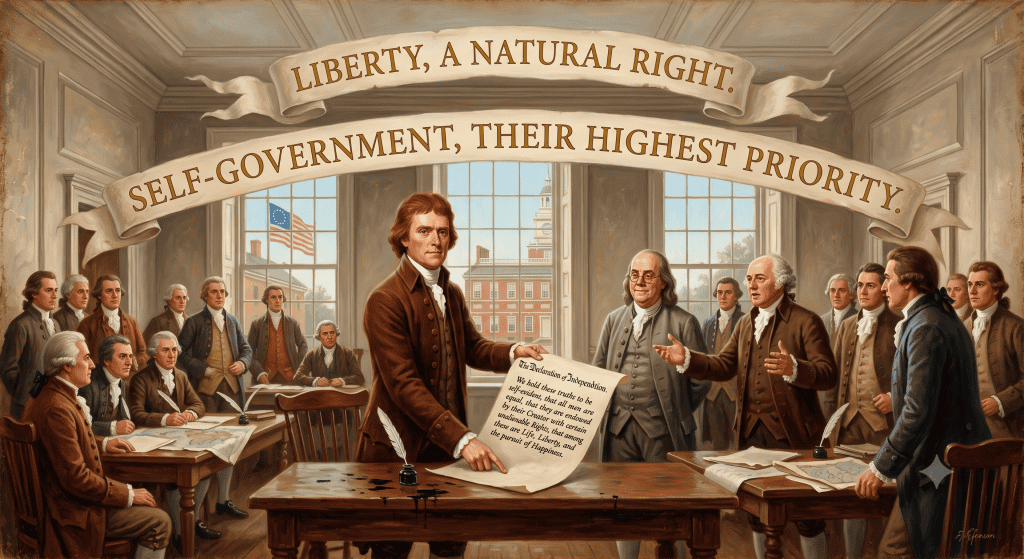
Nearly 250 years ago, the signers of the Declaration of Independence put ink to parchment to affirm a radical idea: that liberty is a natural right, not a privilege granted by a king. The words of that document still ring with extraordinary clarity: “We hold these truths to be self-evident, that all men are created equal… that they are endowed by their Creator with certain unalienable Rights, that among these are Life, Liberty and the pursuit of Happiness.”

It was a bold, world-changing statement — one that ignited a revolution and inspired democratic movements around the globe. But as we mark another Independence Day, it is worth asking: How well are we living up to those ideals?  Can we, indeed, come to the same Independence Day Spirit?

Liberty: A Work in Progress

The founders’ concept of liberty was aspirational from the beginning. In 1776, “liberty” did not include enslaved Africans, Native Americans, or women. The rights declared were not applied equally, even as they were declared universal. And yet, those founding words have proved resilient, not because they were perfect, but because they were visionary.

Over the generations, Americans have fought to close the gap between our ideals and our realities. The abolitionist movement, women’s suffrage, civil rights, LGBTQ+ rights, and immigrant justice — these are not departures from our founding principles, but fulfillments of them.

True patriotism means holding America accountable to its promises. As Frederick Douglass said in his famous 1852 speech, “What to the Slave Is the Fourth of July?” — the holiday means little if freedom is not shared by all. His challenge still echoes today: the Independence Day spirit is not complete until it is universal.

Equality: The Backbone of a Just Society

Equality is perhaps the most demanding ideal in the Declaration. It’s easy to say “all men are created equal” — much harder to create systems that treat people that way. Economic inequality, racial disparities, access to healthcare, education gaps — these issues remain stumbling blocks on the path toward a more perfect union.

But we’ve seen, time and again, that Americans are capable of change. From the 1964 Civil Rights Act to today’s debates about voting rights and criminal justice reform, the journey toward equality continues. Independence Day is a fitting time to recommit ourselves to this cause. It’s not unpatriotic to see where America falls short; it’s deeply patriotic to work toward making it better.

The Pursuit of Happiness: A Right Worth Defending

In few other founding documents is the “pursuit of happiness” named as a right. It’s a beautifully American ideal — not the promise of happiness itself, but the freedom to seek it. This implies freedom of thought, movement, association, enterprise, worship, and expression.

But that freedom must be protected. Civic education, open access to accurate information, fair elections, and public accountability — these are not luxuries but necessities in a society where individuals are empowered to determine their own paths. The pursuit of happiness means little if corruption, censorship, or disenfranchisement limit the journey.

As Thomas Jefferson wrote, “The price of freedom is eternal vigilance.” Our freedoms, like our nation, must be defended not just with arms, but with action—informed voting, public service, peaceful protest, and a shared commitment to truth.

Independence Day is Ongoing

July 4th is a time for gratitude — for those who fought for our freedom, and for the institutions and movements that continue to expand it. But it is also a time for introspection.

Are we doing our part to build a society where liberty, equality, and the pursuit of happiness are not just ideals on parchment, but realities in people’s lives?

Are we educating ourselves and our children on the responsibilities that come with freedom?

Are we building bridges across differences, or walls between us?

This Independence Day, let’s honor the founders not just by waving flags, but by asking the hard questions they left for us to answer. Let’s live our independence — not as a relic of history, but as a daily act of courage, compassion, and civic engagement.

Freedom, after all, is not a finished product. It is a living promise. One we are called to fulfill — together.

Happy Independence Day!


Sources and Further Reading:

This post was first published by Keith Klein for a sister site.  Please feel free to copy and share this post yourself, with an attribution link back to the original here: https://www.wisx.com/independence-day-spirit-2025/

Please contact us with questions.  We do invite you to engage with us on social media (just not for immediate needs). Best to callemail, or visit our site for the best response.

As always, if you like, you will find us on the following social media sites, among many others:

Facebook
LinkedIn
X

Please see a few of our sister sites at these OnYourMark.com LLCA Fine Family of Companies – links:

Memorial Day 2025: Honoring Those Who Gave Their Last Full Measure of Devotion

As we gather across America for Memorial Day 2025, we pause not simply for a day off, but to reflect on the profound sacrifice made by generations of men and women in uniform. Memorial Day is a time to remember those who laid down their lives in service to the United States—those who, in the immortal words of Abraham Lincoln, gave their “last full measure of devotion.”

Remembering Our Fallen Heroes

Memorial Day began in the aftermath of the Civil War, originally known as Decoration Day. Americans would visit cemeteries to decorate the graves of soldiers with flowers, honoring those who had died to preserve the Union. Over the years, the observance expanded to include all U.S. military personnel who died in service.

Memorial Day 2025 marks more than 150 years since this tradition began. Today, it stands as a national moment of unity, remembrance, and gratitude. From the Revolutionary War to recent conflicts, the price of liberty has been paid by brave individuals who believed in the ideals of freedom and democracy.

We honor not just soldiers, but sons and daughters, parents and siblings, friends and neighbors—real people whose stories are woven into the fabric of our nation. Their courage demands not only our respect, but also our remembrance.

The Meaning Behind the Phrase “Last Full Measure of Devotion”

Few phrases better capture the spirit of Memorial Day than Lincoln’s words from the Gettysburg Address. Delivered on November 19, 1863, at the dedication of the Soldiers’ National Cemetery in Gettysburg, Pennsylvania, his speech lasted just over two minutes—but it has echoed through American history ever since.

It is fitting to revisit the full text this Memorial Day 2025, as a tribute to those we honor:

The Gettysburg Address

By Abraham Lincoln
November 19, 1863

Four score and seven years ago our fathers brought forth on this continent, a new nation, conceived in Liberty, and dedicated to the proposition that all men are created equal.

Now we are engaged in a great civil war, testing whether that nation, or any nation so conceived and so dedicated, can long endure. We are met on a great battle-field of that war. We have come to dedicate a portion of that field, as a final resting place for those who here gave their lives that that nation might live. It is altogether fitting and proper that we should do this.

But, in a larger sense, we cannot dedicate—we cannot consecrate—we cannot hallow—this ground. The brave men, living and dead, who struggled here, have consecrated it, far above our poor power to add or detract. The world will little note, nor long remember what we say here, but it can never forget what they did here. It is for us the living, rather, to be dedicated here to the unfinished work which they who fought here have thus far so nobly advanced.

It is rather for us to be here dedicated to the great task remaining before us—that from these honored dead we take increased devotion to that cause for which they gave the last full measure of devotion—that we here highly resolve that these dead shall not have died in vain—that this nation, under God, shall have a new birth of freedom—and that government of the people, by the people, for the people, shall not perish from the earth.

Acts of Remembrance on Memorial Day 2025

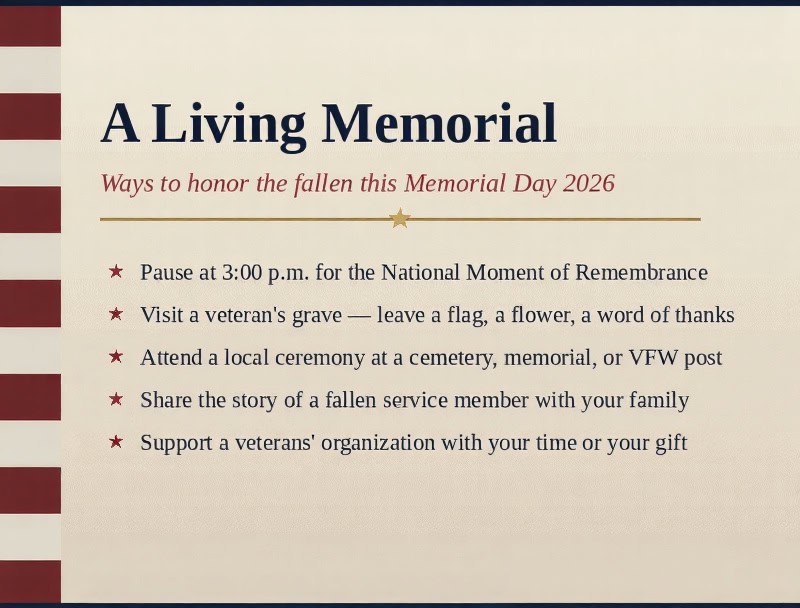
Across the country this Memorial Day 2025, Americans will gather to honor the fallen. Flags will be flown at half-staff until noon. Gravesites will be visited, adorned with flowers and flags. Families will attend ceremonies at national cemeteries, local memorials, and veteran halls. The playing of Taps will ring out in solemn tribute.

At 3:00 p.m. local time, many will join in the National Moment of Remembrance—a simple pause to reflect on the lives sacrificed and the freedoms preserved.

If you are seeking meaningful ways to participate:

  • Attend a local or virtual Memorial Day ceremony.
  • Visit the grave of a fallen service member and leave a flag or flower.
  • Volunteer with a veterans’ organization.
  • Share the Gettysburg Address with your children or grandchildren.
  • Take a moment of silence during your day to remember those lost.

Keeping the Legacy Alive

Let us commit ourselves on Memorial Day 2025 to live lives worthy of the sacrifices made on our behalf. As we enjoy the freedoms they protected, may we never forget the cost at which they came.

Please contact us with questions.  We do invite you to engage with us on social media (just not for immediate needs). Best to callemail, or visit our site for the best response.

As always, if you like, you will find us on the following social media sites, among many others:
Facebook
LinkedIn
X

This Memorial Day 2025 message was both written and optimized by Keith Klein of OnYourMark.com LLC for our friend, client, and partner Mark Mullarky, CEO of Great Lakes Tech Services, with an AI assist via ChatGPT.  Please feel free to use this Memorial Day 2025 blog yourself, with or without the image, with your own modifications, and with attribution via a live link to https://www.GreatLakesTS.com/

« Older posts
Call Now Button